
What Has Possession of You? | Matthew 19:13-30
Most of us walk around with a vague sense that we are not the worst, not the best, probably good enough. We have lowered the bar until Christianity fits the life we were already living.
In Matthew 19:13-30, we walk through three scenes that take that assumption apart. Children brought to Jesus. A rich young ruler who comes with the right question. And Peter asking, "Who then can be saved?" The passage presses on a hard question.
What possesses you, other than Christ, that He is calling you to sell instead of Him? Because Jesus will not share allegiance with another god. And the gospel at the end of the passage is this. He emptied Himself for us, so that we could be made small enough to enter the kingdom we could never earn.
The Heart of Forgiveness | Matthew 18:21–35
Peter thought he was being generous. Seven times. More than double the rabbinic standard. Jesus’s answer blew the question apart. Seventy times seven. Stop counting. In Matthew 18:21-35, we walk through the parable of the unforgiving servant, where a man forgiven zillions refuses to release a hundred denarii. We press on what forgiveness is and what it is not, and we land on the Christ who felt the full weight of what He forgave and paid the debt anyway. Because the heart that has truly received the gospel cannot refuse to extend it.
Recovering Confrontation | Matthew 18:15-20
Church discipline, confrontation, excommunication. These are words most of us would rather not hear from the pulpit. But they come straight from Jesus in Matthew 18:15-20, wrapped in love, not harshness.
This week we press into what it actually means for the church to pursue a brother or sister caught in sin. We lean on Chrysostom and Augustine, we draw the line between sin and personal preference, and we land on the promise that when the church does this hard reconciling work, Christ Himself has promised to be present. Because the church that confronts does the very ministry of the Reconciler, and in doing so, we are conformed to His image.
Ministers of Reconciliation | Keep the Fire Burning
A fire tended only for its own warmth eventually goes out. A fire carried outward keeps burning because it has purpose. This week we close the Keep the Fire Burning series with 2 Corinthians 5:17-21 and Matthew 5:14-16. God has not just reconciled us to Himself. He has entrusted us with the ministry of reconciliation. Every conversation with a neighbor about Jesus, every prayer for a coworker, every moment we choose to name Christ instead of staying silent is another piece of wood on the altar. The fire is meant to be seen. And we are the ones commissioned to carry it into the darkness.

Authentic Community | Keep the Fire Burning
Most Christians who struggle with community are asking horizontal relationships to do vertical work. They are hungry for what only God can give and have been asking a spouse, a friend, or a small group to be their ultimate source. And when the horizontal cannot deliver, the relationships collapse under a weight they were never meant to carry.
This week we press into authentic community as the overflow of a healthy vertical, not a substitute for it. Because when your relationship with God is right, the horizontal overflows into shared life, open homes, thick skin toward offense, and a love the world will recognize as the mark of Christ.
Biblical Literacy | Keep the Fire Burning
Not all fire is God's fire. This week we press into biblical literacy as the fuel that keeps our fire authentic. Jesus met the wilderness with the Word. The Bereans tested even an apostle against the Scriptures. And every one of us is invited to pursue the One the whole Book is about. Because reading the Bible is not about knowing a Book. It is about knowing a Person.
Intimate Pursuit of the Holy Spirit | Keep the Fire Burning
The fire on the altar was never something the people manufactured. God brought it. Their job was to keep it burning by bringing wood. This week we press into the intimate pursuit of the Holy Spirit and the two ditches that swallow most churches on this value.
The Spirit is not just God's presence with us. He is God's power in us. Without Him, the Christian life is impossible. With Him, we bear fruit we could never produce on our own.
Walking the Path of Jesus | 1 John 2:1-11
John writes so that we won't sin, but he doesn't leave us without hope when we do. Jesus is our Advocate before the Father, and He Himself is the atoning sacrifice for our sins. In this passage, John shows us what it actually looks like to know Him: obedience to His commands and love for the people around us. The command to love isn't new, but it takes on new weight in the light of Christ. Anyone who claims to walk in the light while hating a brother or sister is still in the dark.
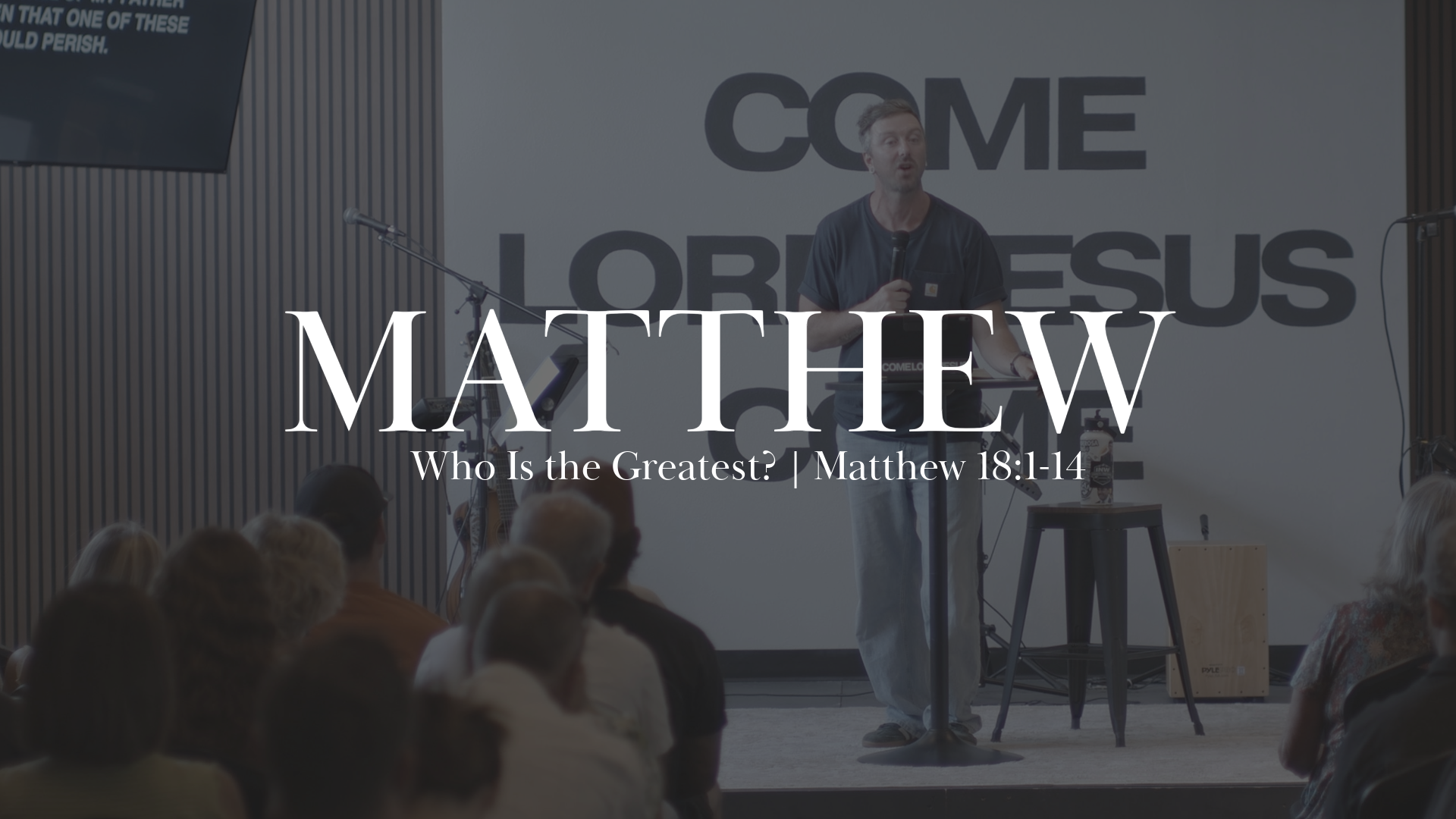
Who Is the Greatest? | Matthew 18:1-14
The disciples asked Jesus who was the greatest in the kingdom of heaven. Instead of ranking them, Jesus placed a child among them and told them that unless they became like that child, they would not enter the kingdom at all. This week we walk through Matthew 18:1–14 and press on what Jesus actually asks of us.
Cut off the sin you have been calling private, because it is not just yours. It is forming the little ones around you. And stop assuming that maturity is measured by how long you have been in the pew. Christian maturity is Christlikeness, and the mature Christian is the one who knows he is still a little one who comes when Jesus calls.

The Great Ransom | Matthew 17:22-27
Most Bibles put a subheading between Matthew 17:23 and Matthew 17:24, as if the death Jesus predicts and the temple tax conversation are two different stories. They are not. Matthew placed them together on purpose. The cross interprets the tax. And when we read the passage as Matthew wrote it, we see something remarkable.
Jesus, having just told His disciples that He is about to die, quietly pays a ransom into a temple sacrificial system He is about to fulfill and end. He was free from every obligation. He owed nothing. And He chose to pay it anyway, because a greater ransom was coming, one that would set us free forever. This week we walk through the two payments Christ makes, and the "so now, I" response that flows from a life bought at a price.
Faith That Moves | Matthew 17:14-20
The disciples had authority, experience, and years of watching Jesus heal, cast out demons, and feed thousands. And yet when a father brought his suffering son, they could not do what they had been given authority to do.
Jesus diagnosed their problem: little faith. Most Christians hear that and immediately conclude they need to build more of it, but Jesus is not telling His disciples to grow bigger faith. He is telling them that even the smallest faith, if it is placed on Him, moves mountains.
This week we walk through Matthew 17:14-20 and discover the freedom of stopping the effort to hold ourselves up and leaning our whole weight on the One who holds.
The Desires of Your Heart | Psalm 37:1–11
As we close the Recovering Context series, we walk into what Psalm 37 actually promises. Not the delivery of what you already want. The reshaping of what you want in the first place. God is working on the desires themselves, and the sign He is at work is not the arrival of the outcome. It is the slow, deep discovery that He is what you were always made to want.
More Than You Can Handle | 1 Corinthians 10:1-14
We have all heard someone say, "God will not give you more than you can handle." That sentence has done real damage in the church, and it is not what 1 Corinthians 10:13 actually says.
Paul is not writing about suffering. He is writing about temptation. And the promise he actually makes is one of the most freeing in the New Testament. This week we recover the context of the verse that has crushed people who were already crushed, and discover a God whose sufficiency reaches into the very places our capacity ends.
Faithful to the Unfaithful | Jeremiah 29-4-14
Jeremiah 29:11 is probably the most misused verse in modern Christianity. We have made it a personal promise about a pleasant future, even though Jeremiah wrote it as a rebuke of false prophets who were promising personal pleasant futures.
The real verse is not smaller than the coffee mug version. It is far larger. It reveals a God whose covenant faithfulness endures even when His people break faith, and who does formative work in the exile that could not occur anywhere else.
This week we recover the context of Jeremiah 29 and discover that the exile is not a season to survive on the way to somewhere better. It is where God is forming us into the people we could not have become anywhere else.

Content In Anything | Philippians 4:13 | Recover Context
Many people have used Philippians 4:13 to summon the strength to accomplish what they wanted. Paul wrote it from a prison cell about learning contentment in plenty and in hunger. The actual promise is not that Christ will help you win. It is that Christ will strengthen you to be at peace no matter what life throws at you.
None But Jesus | Matthew 17:1-13
Most of us are not refusing Jesus. We are filtering Him. We hear the parts that confirm what we already believed and quietly set aside the parts that would cost us something. We have made Him one voice among many in a life that is already crowded with louder voices.
Matthew 17 is the day The Father settled who Jesus is and how He is to be heard. On the mountain, the Father did not say listen to them all and figure out the consensus. He said listen to Him. This sermon walks through the Transfiguration, the voice from the cloud, and the road down the mountain toward the cross, and asks the question every Christian eventually has to answer. Which voice wins when Jesus contradicts another?

The Cross That Wounds You | Matthew 16:24-28
Most of us have softened the call of Jesus until it fits inside the life we had already designed. Most of us have softened the call of Jesus until it fits inside the life we had already designed. We reference the cross, we sing about it, we wear it, but we have not actually taken it up. Matthew 16:24-28 confronts the comfortable middle ground and asks what we are really telling Jesus about His worth when we refuse to carry what He has asked us to. The cross you carry should wound you, and the One who carried His first is worth everything it costs.
Get Behind Me | Matthew 16:21-23
When Jesus announces His coming suffering, death, and resurrection, Peter pulls Him aside and rebukes Him, only to receive a startling rebuke in return. This sermon examines Jesus' confession of what lies ahead, the nature of Peter's correction, Jesus' counter-rebuke, and the diagnosis and remedy Peter needed to set his mind back on the things of God.

Who Do You Say That I Am? | Matthew 16:13-20
Everyone has an opinion about Jesus. The crowds in His day had their answers, and the world today has no shortage of its own. But Jesus doesn't ask what everyone else thinks. He turns and asks you directly: “Who do you say that I am? ”
That question has never been more loaded, and it has never mattered more to get right. What you believe about Jesus shapes everything about how you live, what you surrender, and what you're no longer ashamed of. Peter's answer changed the trajectory of history. Yours might change yours.
The Danger of Forgetfulness | Matthew 16:1-12
Most of us are living with a quiet dissatisfaction, the sense that what God has given us is somehow not enough. We pray for new signs, new clarity, new proof, as we walk past the cross, the empty tomb, and the long history of His faithfulness in our lives. Matthew 16:1-12 confronts two ways the human heart drifts away from Jesus and shows us that the cure for both is the same. Remember Him. He is sufficient.